

Where BMI comes from: Quetelet, the “average man” and a formula nearly 200 years old
The number on every doctor’s chart was never meant for doctors. It began as a Belgian astronomer’s attempt to describe whole populations. Here is how it works, where it came from, and what it can and can’t tell you.

Key points
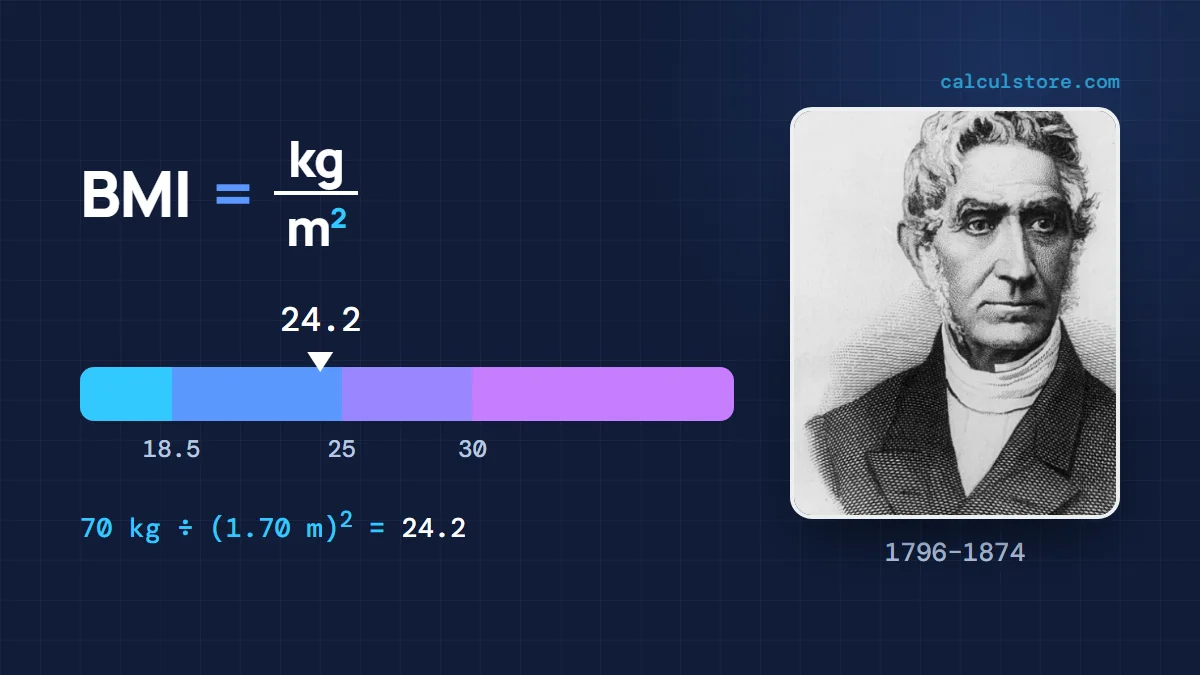
- BMI is weight in kilograms divided by the square of height in metres.
- Adolphe Quetelet worked out the ratio between 1830 and 1850, to describe populations.
- Ancel Keys and his colleagues named it “body mass index” in 1972.
- It is a quick screening number, not a diagnosis: it can’t see muscle, fat or where fat sits.
The formula in one line
Body mass index takes two measurements and returns one number: your weight in kilograms divided by your height in metres, multiplied by itself.
Take someone who weighs 70 kg and is 1.70 m tall. Their height squared is 1.70 × 1.70 = 2.89, and 70 ÷ 2.89 = 24.2.
In pounds and inches, the same formula needs a conversion factor of 703. Someone who weighs 154 lb and is 5 ft 7 in tall (67 inches) has a BMI of 154 × 703 ÷ 67² = 24.1.
Work out your own BMIMetric or imperial, with your result explainedWho was Adolphe Quetelet?
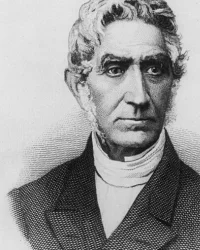
Adolphe Quetelet was born in Ghent in 1796. He began teaching mathematics at 19, earned a doctorate in mathematics from the University of Ghent in 1819, and then persuaded the authorities and private donors to build an astronomical observatory in Brussels, which he went on to direct.
Astronomy taught him a powerful tool. Astronomers took many slightly different measurements of the same star and used statistics to find the true value hidden among the errors. Quetelet wondered whether the same methods could describe people.
He called the idea “social physics”: using measurement and statistics to find the regular patterns behind births, deaths, crime and the human body. It made him one of the first people to apply statistics to society.
The “average man”
In 1835 Quetelet published his most influential book, Sur l’homme et le développement de ses facultés, or “On man and the development of his faculties”. In it he described l’homme moyen, the “average man”: a person defined by the mean of each measured trait across a population.
Measuring adults, he noticed that weight does not grow in step with height. Instead, it tends to rise with the square of height. Dividing weight by height squared therefore gave a figure that stayed fairly steady from short adults to tall ones. That ratio became known as the Quetelet index.
It is worth being honest about the context. Quetelet treated the average as an ideal, and his thinking influenced Francis Galton, who later coined the word eugenics. The index itself is simple arithmetic, but it grew up in a century that used statistics to rank people.
How the Quetelet index became BMI
For more than a century the ratio stayed a statistician’s tool. Interest returned in the twentieth century, as doctors watched obesity rise in prosperous Western countries and looked for a simple way to measure it.
In July 1972 the American physiologist Ancel Keys and his colleagues compared several weight-for-height indices in the Journal of Chronic Diseases. They concluded that weight divided by height squared was, if not perfect, at least as good as any other, and they gave it a new name: body mass index.
Keys was clear about its purpose. He judged BMI suitable for studying populations, and unsuitable for judging one person. That warning is still the most important thing to know about it.
Reading your number
For adults, the World Health Organization groups BMI into four main bands. The same thresholds apply to men and women.
| BMI | Category |
|---|---|
| Under 18.5 | Underweight |
| 18.5 to 24.9 | Healthy weight |
| 25 to 29.9 | Overweight |
| 30 or more | Obesity |
Children and teenagers are different. Between the ages of 2 and 20, BMI is worked out in the same way but compared with other children of the same age and sex. Below the 5th percentile counts as underweight, from the 85th to the 95th as overweight, and above the 95th as obese.
What BMI can’t tell you
BMI is quick, free and needs no equipment, which is why it is everywhere. But a single number built from two measurements leaves a lot out.
- Muscle and fat weigh the same on a scale. A muscular athlete can have a BMI in the overweight range with very little body fat.
- It can’t see where fat sits. Fat around the waist carries more health risk than fat elsewhere, and two people with the same BMI can differ a lot.
- Height doesn’t scale perfectly. Because weight grows faster than height squared, very tall people tend to get slightly higher results than their body fat would suggest.
- The original data was narrow. Quetelet’s measurements came mostly from Scottish Highland soldiers and French gendarmes, so the scale fits some groups better than others.
That is why doctors use BMI as a first look, alongside other measures such as waist size, and not as a verdict on anyone’s health.
Questions
Who invented BMI?
The Belgian statistician Adolphe Quetelet devised the ratio between 1830 and 1850, when it was called the Quetelet index. Ancel Keys and his colleagues gave it the name body mass index in 1972.
Why is height squared in the BMI formula?
Quetelet found that in adults, weight tends to rise with the square of height. Dividing by height squared gives a number that stays fairly steady across short and tall people.
Is BMI accurate for athletes?
Not very. BMI can’t tell muscle from fat, so people with a lot of muscle often get a high result even when their body fat is low.
Sources
- Wikipedia: Body mass index
- Wikipedia: Adolphe Quetelet
- Encyclopaedia Britannica: Adolphe Quetelet
- PubMed: Keys et al., Indices of relative weight and obesity, 1972
This article is for general information. It is not medical advice: please talk to a doctor about your own health.