

The rule of 72: how long does it take to double your money?
Divide 72 by the interest rate and you get the number of years it takes money to double. It sounds too simple to work, yet bankers have used it for more than 500 years. Here is how to use it, why it works, and where it stops working.

Key points
- Years to double ≈ 72 ÷ the yearly interest rate in percent.
- At 6% a year, money doubles in about 12 years; at 9%, in about 8.
- The rule only works for compound interest, and is most accurate between about 6% and 10%.
- It appears in Luca Pacioli’s Summa de arithmetica of 1494, and is probably older still.
The rule in one line
To estimate how many years an investment needs to double, divide 72 by its yearly rate of return, written as a percentage.
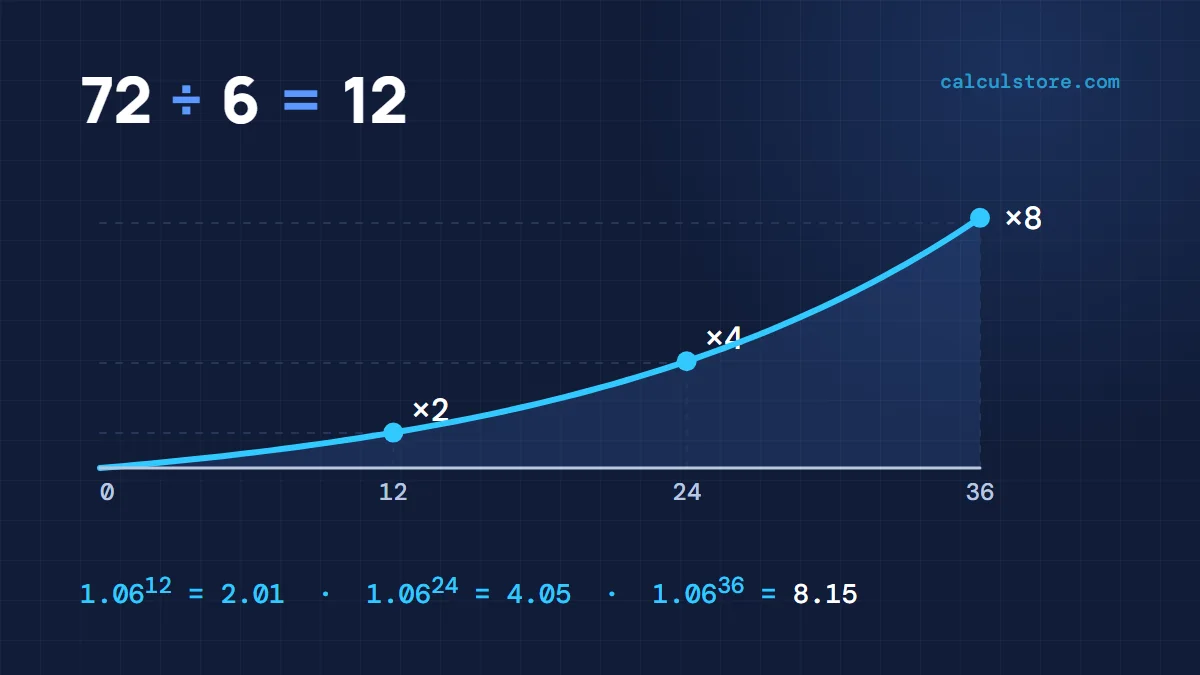
Put 10,000 in a savings account paying 6% a year, with the interest added each year. The rule says 72 ÷ 6 = 12 years to double. The exact answer is 10,000 × 1.06¹² = 20,122 after 12 years, so the rule is almost spot on.
Keep going and the doubling repeats: 20,000 after about 12 years, 40,000 after 24 and 80,000 after 36. That repeated doubling is what makes compound interest so powerful over long periods.
See your own money growCompound interest with any rate, period and regular depositsA table to keep in your head
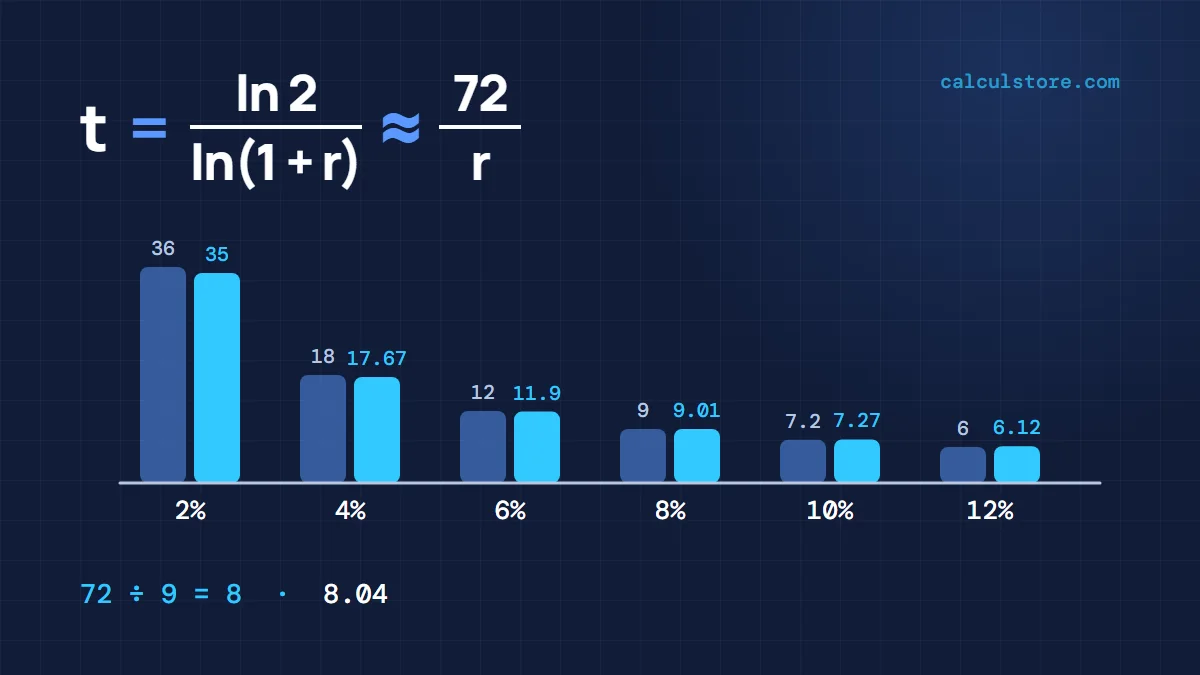
Here is the rule next to the exact doubling time for common rates, with interest added once a year.
| Rate per year | Rule of 72 | Exact years |
|---|---|---|
| 2% | 36 | 35.0 |
| 3% | 24 | 23.4 |
| 4% | 18 | 17.7 |
| 6% | 12 | 11.9 |
| 8% | 9 | 9.0 |
| 9% | 8 | 8.0 |
| 10% | 7.2 | 7.3 |
| 12% | 6 | 6.1 |
Between 4% and 12% the rule is never more than about four months out. At 2% it overestimates by a year, which still makes it a useful first guess.
Why 72 works
Money growing at a rate r doubles when (1 + r) multiplied by itself t times reaches 2. Solving for t gives the exact formula: t = ln 2 ÷ ln(1 + r), where ln is the natural logarithm.
Since ln 2 is about 0.693, for small rates the exact answer is close to 69.3 ÷ r. So why 72? Partly because 72 has so many divisors, 1, 2, 3, 4, 6, 8, 9 and 12, which makes the division easy in your head. And partly because at typical rates of 6% to 10% with yearly compounding, 72 actually gives a closer answer than 69.3.
When interest is added daily or continuously, 69.3 becomes the more accurate number, and many people use the rule of 70 as an easy compromise.
Older than you think
Compound interest is ancient, but writing down how it grows took longer. Around 1340, the Florentine merchant Francesco Balducci Pegolotti included a table in his book Pratica della mercatura showing the interest on 100 lire at rates from 1% to 8% for up to 20 years.
The rule of 72 appears in 1494 in the Summa de arithmetica of Luca Pacioli, the Italian friar often called the father of accounting. His example is the one above: at 6% a year, divide 72 by 6 to get 12 years. Pacioli gives the rule without proving it, which suggests it was already in use before him.
Almost two centuries later, in 1683, Jacob Bernoulli asked what happens when interest is added more and more often. The answer led him to the number e, about 2.718, which sits inside the exact doubling formula above.
Inflation, fees and halving
The same trick works for anything that grows or shrinks by a steady percentage.
- Inflation. At 3.5% inflation, prices double, and the buying power of your money halves, in about 70 ÷ 3.5 = 20 years.
- Fees. A 3% yearly fee on an investment cuts its value in half in roughly 72 ÷ 3 = 24 years, compared with the same investment without the fee. The exact figure is nearer 23.
- Targets. To double your money in 10 years, you need roughly 72 ÷ 10 = 7.2% a year.
Where the rule breaks down
- High rates. At 24% a year the rule says 3 years, but the exact answer is 3.2. At high rates, dividing 78 instead gives a closer answer.
- Simple interest. If interest is not reinvested, 6% a year takes 100 ÷ 6 = 16.7 years to double, not 12.
- Changing returns. The rule assumes the same rate every year. Real investments go up and down, so treat it as a guide, not a promise.
Questions
How accurate is the rule of 72?
For yearly compounding at rates between 4% and 12%, it is within about four months of the exact answer. It becomes less accurate at very low or very high rates.
What is the difference between the rule of 72 and the rule of 70?
They estimate the same thing. 70 is closer when interest is added daily or continuously, and is often used for inflation; 72 is closer for yearly compounding and divides more easily.
Who invented the rule of 72?
Nobody knows. Its earliest known appearance is in Luca Pacioli’s Summa de arithmetica of 1494, but he presents it without proof, so it was probably already known.
Sources
- Wikipedia: Rule of 72
- Wikipedia: Compound interest
- Wikipedia: Luca Pacioli
- Encyclopaedia Britannica: e (mathematics)
This article is for general information. It is not financial advice: returns are never guaranteed, so please speak to a qualified adviser before an important decision.