

Percentage increase and decrease: the formulas, and the traps that catch everyone
A price goes up 50%, then down 50%, and you end up paying less than you started with. Percentages are everywhere, from pay rises to discounts and interest rates, and a few simple rules explain almost every surprise they cause.

Key points
- Percentage change = (new value − old value) ÷ old value × 100.
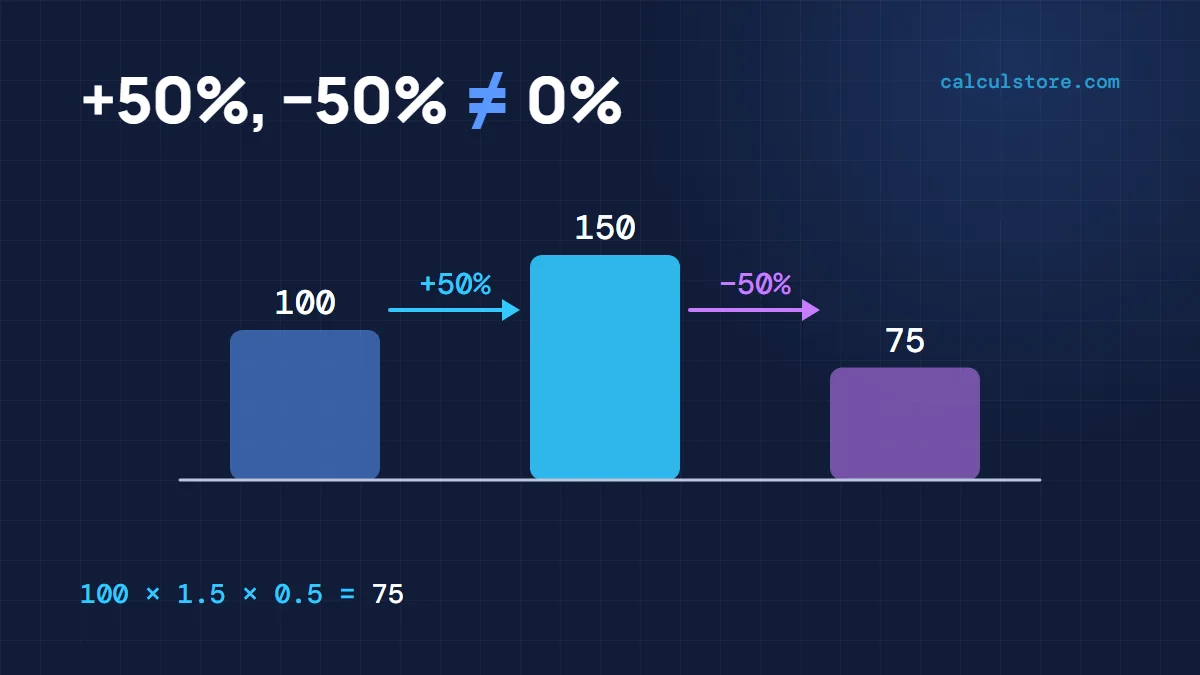
- A rise and a fall of the same percentage don’t cancel out: +50% then −50% leaves you 25% down.
- To undo a discount, divide by what is left; don’t add the percentage back.
- From 4% to 5% is a rise of 1 percentage point, but a 25% increase.
The percentage change formula
A percentage change compares the difference between two values with the value you started from.
If a coffee goes from 2.50 to 2.65, the change is 0.15, and 0.15 ÷ 2.50 = 0.06: a 6% increase.
The same formula gives decreases, which come out negative. A train ticket that falls from 80 to 60 has changed by (60 − 80) ÷ 80 = −0.25, a 25% decrease.
Work out any percentageIncrease, decrease, percentage of a number and moreWhy a rise and a fall don’t cancel
Start with 100 and add 50%: you get 150. Now take 50% off. Half of 150 is 75, so you finish with 75, a quarter less than where you began.
The reason is that each percentage is taken from a different starting value. The rise is 50% of 100, but the fall is 50% of 150. A useful way to see it is to multiply instead: rising by 50% means multiplying by 1.5, falling by 50% means multiplying by 0.5, and 1.5 × 0.5 = 0.75.
To get back to where you started, the fall has to be smaller than the rise. A 25% increase, from 100 to 125, is undone by a 20% decrease, because 125 × 0.8 = 100.
| After a rise of | The fall that undoes it |
|---|---|
| 10% | 9.1% |
| 20% | 16.7% |
| 25% | 20% |
| 50% | 33.3% |
| 100% | 50% |
The rule behind the table: after a rise of x%, the fall that brings you back is x ÷ (100 + x), written as a percentage.
Finding the original price
The same trap catches people working backwards. A jacket costs 80 after a 20% discount. What was the original price?
Adding 20% back gives 80 × 1.2 = 96, which is wrong. The discount was 20% of the original price, so 80 is 80% of it. Divide instead: 80 ÷ 0.8 = 100.
Sales tax and VAT work the same way. If a price of 120 includes 20% VAT, the price before tax is 120 ÷ 1.2 = 100, not 120 minus 20% of 120, which would give 96.
Percent or percentage points?
When the thing that changes is itself a percentage, such as an interest rate or a share of the vote, there are two different ways to describe the change.
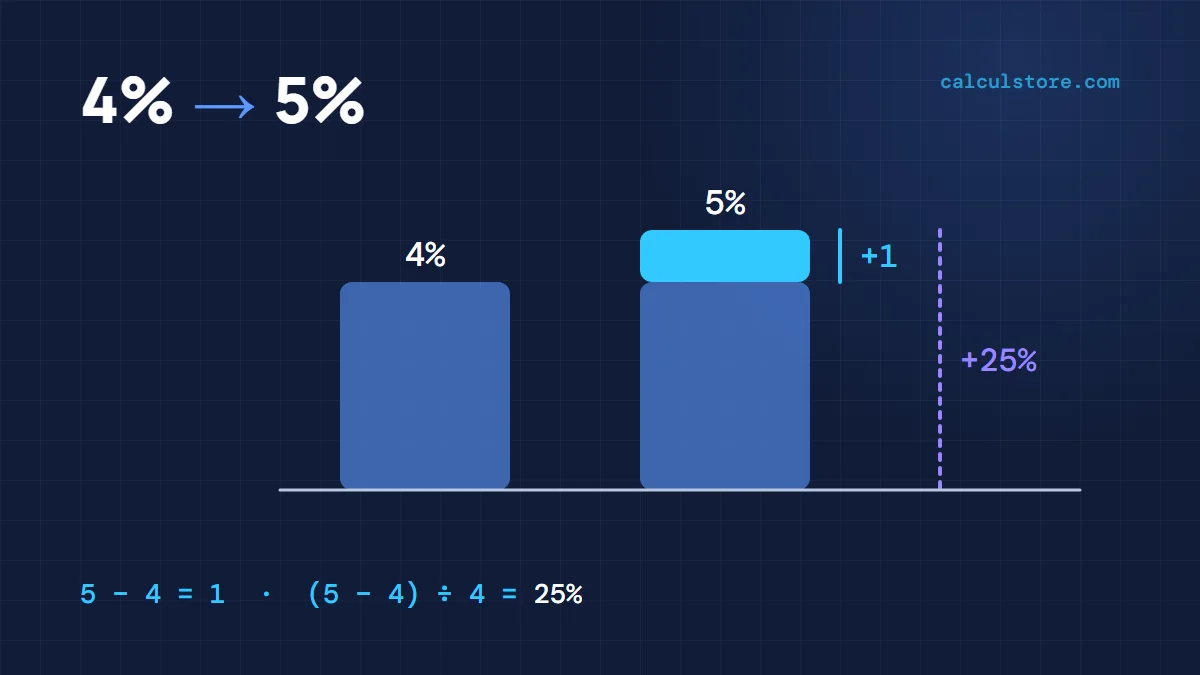
If a mortgage rate goes from 4% to 5%, it has risen by 1 percentage point: the simple difference, 5 − 4. But compared with where it started, it has risen by 25%, because 1 ÷ 4 = 0.25. Both statements are true, and news reports often mix them up.
A good habit is to use “percentage points” for differences between percentages, and “percent” only for relative changes.
Changes of more than 100%
- An increase of 100% doubles a value: 100% of the original plus another 100%.
- An increase of 800% makes something nine times as large, not eight.
- A decrease of 100% takes a value to zero, so nothing can fall by more than 100%.
Where the % sign comes from
Counting by the hundred is old. In ancient Rome, the emperor Augustus charged a tax of one part in a hundred on goods sold at auction, and calculations in hundredths worked just like percentages.
As trade grew in the Middle Ages, Italian merchants wrote per cento, “for a hundred”. Over time the abbreviation shrank: the “per” disappeared, and “cento” was squeezed into two small circles with a line between them, the % sign we use today. No special symbol for percentages is known from before 1425, and by the 17th century it was standard to quote interest rates in hundredths.
Questions
How do I calculate a percentage increase?
Subtract the old value from the new one, divide by the old value, and multiply by 100. From 40 to 50: (50 − 40) ÷ 40 × 100 = 25%.
Why doesn’t a 50% fall undo a 50% rise?
Because the fall is taken from the higher value. 100 rises 50% to 150, and 50% of 150 is 75, so you end up at 75.
What is the difference between percent and percentage points?
Percentage points are the simple difference between two percentages. Going from 4% to 5% is 1 percentage point, but a 25% increase.